
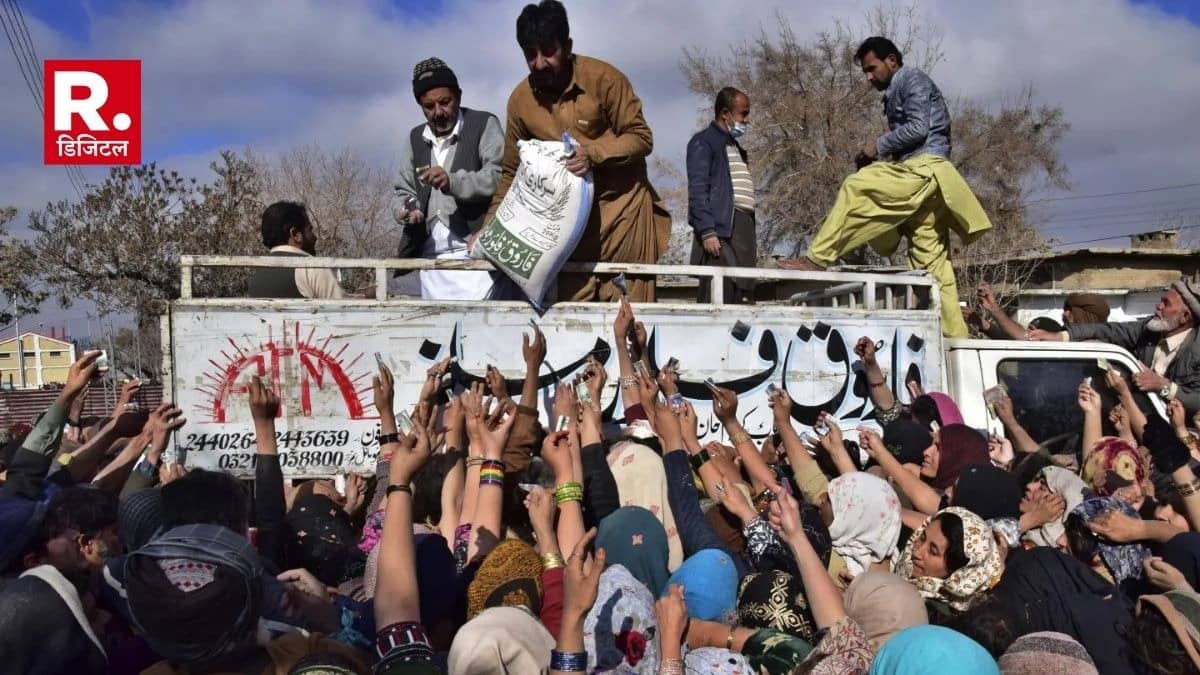
Pakistan News: Poverty is increasing very fast in Pakistan. According to the recent report of Social Policy and Development Center (SPDC), a leading think tank of the country, the poverty rate in Pakistan has increased to 43.5 percent. This figure is much higher than the official estimate of 28.9 percent given by the Pakistan Bureau of Statistics (PBS) and the Planning Commission. There is a huge difference of 14.6 percent between the two.
This shocking revelation has been made in the SPDC report. The report shows that while the poverty rate was 36.6 percent in 2018-19, it has increased to 43.5 percent in 2024-25. During this period, about 2.7 crore additional people have been pushed below the poverty line. The most worrying thing is that the increase in poverty in urban areas has been faster than in rural areas.
Urban poverty increased to 42.1 percent from 32.1 percent in 2018-19, while rural poverty rose to 44.3 percent from 39.3 percent. This means that the condition of people living in cities has become worse than that in rural areas. Generally, in developing countries, poverty is considered to be more in rural areas, but the reverse is happening in Pakistan.
Question on official figures
SPDC has clearly stated that the government’s figures are far from reality. The Pakistan Bureau of Statistics uses the ‘Cost of Basic Needs’ method, in which the old poverty line is updated with the Consumer Price Index (CPI). But the SPDC says this approach ignores the real needs of low-income families. In this, adequate attention is not given to health services, clean water and other essential expenses.
the government is playing
SPDC, on the other hand, has adopted the ‘Food Energy Intake’ approach, which links household expenditure to minimum calorie needs. According to this method, the poverty line for urban areas in 2024-25 has been fixed at Rs 13,476 per month and for rural areas at Rs 10,283 per month. Whereas in government figures it has been kept at only Rs 8,484. That means the government is deliberately keeping the poverty line low, so that the number of poor appears less.
SPDC Managing Director Muhammad Asif Iqbal said that the calorie-based method is more accurate in developing countries, because poor families there spend more than half of their income on food.
Income inequality increased rapidly
Citing data from the Household Integrated Economic Survey (HIES) 2024-25, the report said that income inequality is also increasing rapidly. The gap between the rich and the poor is widening, especially in urban areas. A larger share of wealth and income is becoming concentrated in the upper income group.
Very difficult for common people
The SPDC report clearly indicates that the standard of living in Pakistan is declining widely, especially in the cities. Rising inflation, unemployment, energy crisis and political instability have made the life of common people very difficult. Middle and lower class people living in cities are now unable to meet even their basic needs.
taunt on the government
The government of Pakistan has often claimed that its policies are reducing poverty and improving the economy. But the report of an independent organization like SPDC directly refutes this claim. When the official figures do not match the reality so much, the question arises whether the government is really working towards reducing poverty or is just misleading the public by playing the numbers game.
Such a rapid increase in urban poverty is an indication that even in big cities, people are now finding it difficult to survive. Despite taking loans from international institutions like IMF and World Bank, the condition of the common Pakistani is worsening instead of improving.
Also read: US: Huge demonstration against Trump in their own country, millions of Americans took to the streets in ‘No Kings’ march against Iran war