
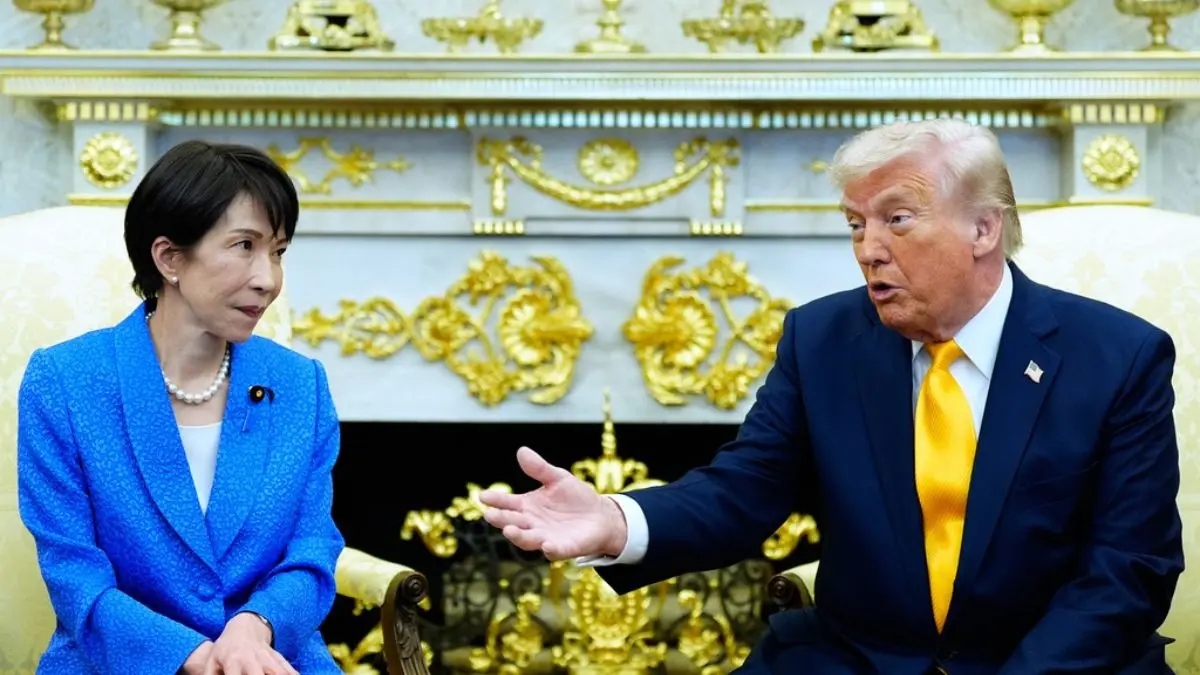
President Donald Trump speaks during a meeting with Japan’s Prime Minister Sanae Takaichi. Image:AP
Senior US and Japanese officials speak very carefully in public about Japan’s surprise attack on US forces at Pearl Harbor in 1941, and generally avoid speaking on the subject. So there was embarrassment, confusion and unease in Japan on Saturday when President Donald Trump casually invoked that World War II attack to justify his secrecy before launching a war against Iran.
Japan’s uneasiness was further increased by the fact that when Trump was speaking, Japanese Prime Minister Sanae Takaichi was sitting next to him, feeling somewhat uncomfortable. In part, this reaction is related to the important security and economic role that the United States plays for Japan, its largest ally in the region. Simply put, Japan needs to ensure that its relationship with the United States remains strong. That’s why Takaichi was in Washington.
Why embarrassment even after 80 years?
But it is also an indication of how fresh the political debate about Japan’s role in the Second World War is still here, even though 80 years have passed since that war ended. Many senior leaders, including Takaichi, argue that Japan has apologized enough for whatever happened during the war. Takaichi himself has recently hinted at visiting Tokyo’s controversial Yasukuni Temple; This temple honors the 2.5 million people killed in the war as well as Japan’s war criminals.
However, it is somewhat shocking for Japan that these questions related to history came up even in a summit meeting held at the White House. On Friday, when a Japanese journalist asked Trump why he did not inform his allies in Europe and Asia before the US attack on Iran, Trump cited Pearl Harbor to defend his decision, saying, “Who knows better than Japan about surprise attacks? Why didn’t you tell me about Pearl Harbor? Right?”
allegations of misbehavior
There were different types of reactions from people on social media. Some people accused the American President of foolishness and rudeness, while some said that he does not consider Japan as an equal partner. There was also a demand from Japan to oppose Trump’s words.
Suneo Watanabe, a senior fellow at the Sasakawa Peace Foundation, said in an online article published in the Nikkei newspaper on Saturday that the comments indicated that Trump was “not bound by the current common understanding of America.” Watanabe said, “It seems to me that this comment was made with the intention of involving the Japanese reporter (who asked the question) or Takaichi in this matter, so as to justify their ‘surprise attack’ on Iran during diplomatic talks and without informing the allies.
Both countries need each other
It is also felt that there is an unwritten understanding between the leaders of America and Japan that this issue should be proceeded with great caution. Both parties need each other; While Washington depends on Japan to maintain 50,000 troops and many powerful high-tech weapons, Japan depends on America’s nuclear security (nuclear umbrella) to deter its enemy and nuclear-armed neighbors.
Japan’s constitution, enacted after World War II, prohibits the use of military force except in self-defense, but Takaichi and other officials are now trying to expand the military’s role. When it comes to reconciliation between the US and Japan, many people cite the example of former leaders Barack Obama and Shinzo Abe; In 2016, both these leaders had paid tribute together at the Arizona Memorial and Hiroshima Peace Park at Pearl Harbor.
Mixed reactions to Japan’s leader
Despite being a staunch conservative leader, Takaichi was praised for not reacting to Trump’s comments; He simply rolled his eyes and glanced towards his ministers sitting nearby, thereby ignoring the comments.
After all, the main purpose of their summit was to further strengthen relations with their most important ally, not to debate the second world war. She arrived there as Trump indicated that Japan was one of the countries that did not immediately support his call to help secure the Strait of Hormuz. However, some people also criticized Takaichi for not raising his voice on this issue.
Hitoshi Tanaka, a former diplomat and special advisor to the Japan Research Institute think tank, wrote on ‘X’ (Twitter) that he felt embarrassed to see Takaichi flattering Trump. “As national leaders, they are equal to each other. Maintaining an equal relationship does not mean flattery,” he said. He further said, “To do only what makes Trump happy, and then consider it a success if no harm is done to you, is very sad.”
Also read: Trump got America caught in the war, how did the situation go out of control?