
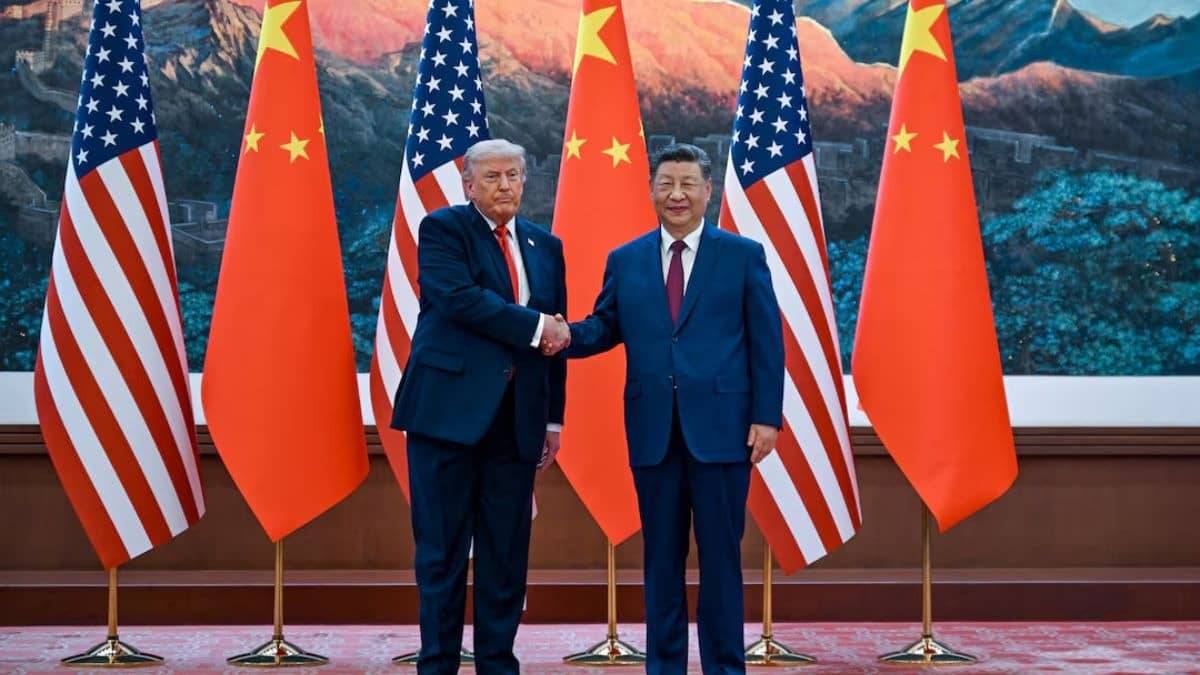
US President Donald Trump described China’s Xi Jinping as a great leader and friend. The two leaders began two days of talks on Thursday, in which issues such as their fragile trade deal, the Iran war and US arms sales to Taiwan are to be discussed.
This much-awaited visit to China has become even more important in view of the blow to Trump’s approval rating due to his entanglement in Middle East affairs. Let us tell you that this is the first time since 2017 that an American President has visited this country, America’s main strategic rival.
Meanwhile, the most noteworthy thing is the digital lockdown of Trump and his team. Security personnel and officials have left their everyday mobile phones behind in their journey to Beijing.
What is the reason for this ‘digital lockdown’?
Officials traveling to China often take with them “clean” devices, makeshift laptops and tightly controlled communications systems designed to reduce the risk of espionage, hacking or data theft. US officials consider China’s environment one of the most aggressive cyber environments in the world.
Because of these precautions, even simple everyday tasks turn into huge logistical problems. Messages that would normally be delivered instantly through encrypted apps or synced devices are instead sent through controlled channels, temporary accounts, or in person.
Contacts disappear. Cloud access becomes limited. Some executives work for days without their usual digital footprint. Current and former officials say the measures reflect a long-held belief within the U.S. government: Anything brought into China — whether it’s a phone, laptop, tablet or even a hotel Wi-Fi connection — should be considered potentially compromised.
Charging the phone is also a matter of safety concern
These precautions are not limited to government officials only. The delegation traveling with Trump also includes executives from big American companies like Apple. These are companies that work at the center of the economic and technological relationship between the US and China.
In Washington, officials are often asked to leave their phones behind when visiting places like the Chinese Embassy. These concerns are heightened when traveling to China, where US officials operate with the assumption that their devices, networks and even hotel rooms can be monitored. Even charging the phone can become a safety concern.
Federal cybersecurity guidelines have long warned travelers not to connect their devices to unknown USB ports or untrusted charging systems, as rogue hardware could be used to extract data or insert harmful software. This method is commonly referred to as “juice jacking”.
Also read: Trump started praising Jinping; Will China give them ‘that’?