
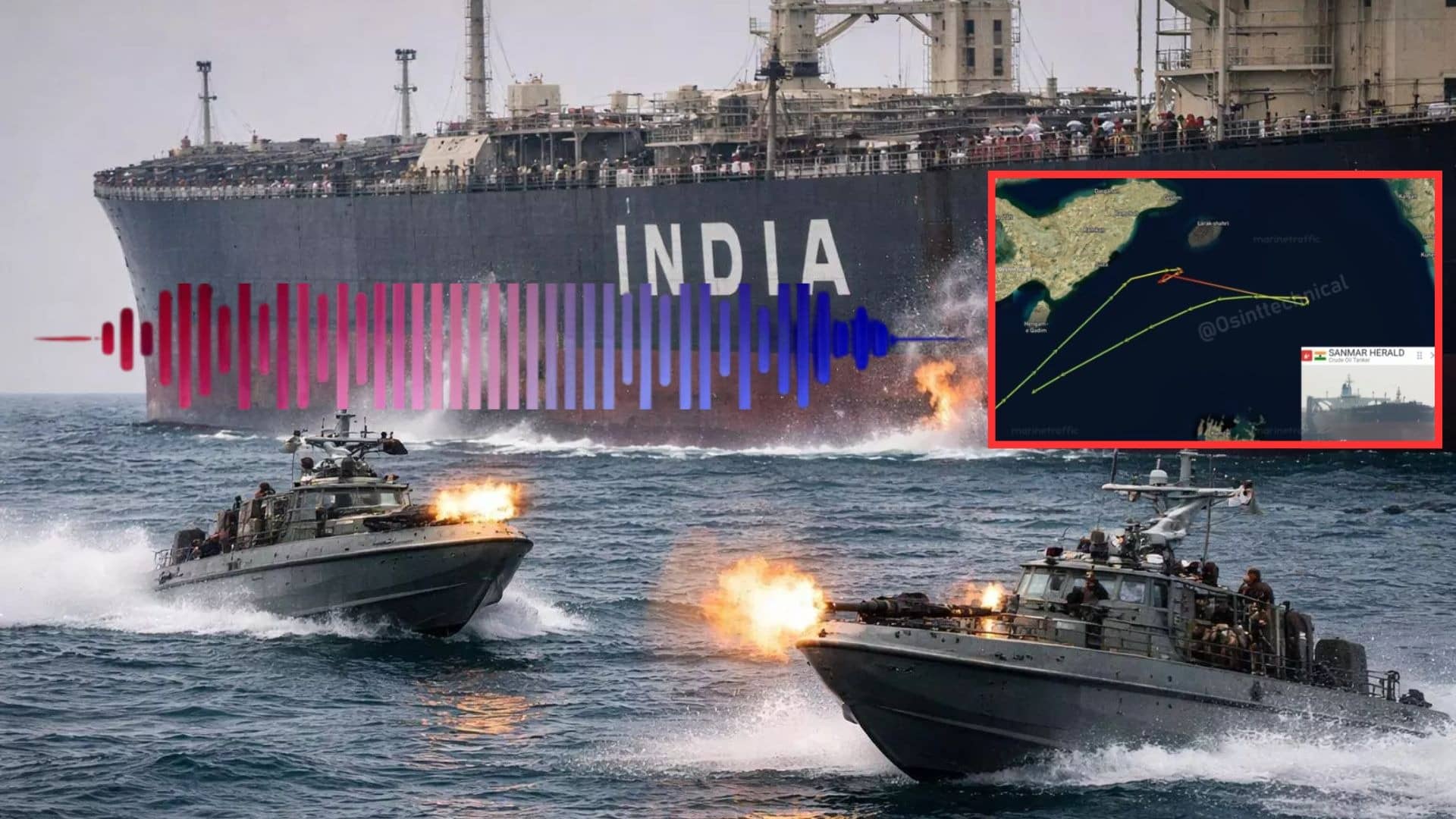
The incident of firing by Iran’s Islamic Revolutionary Guard Corps (IRGC) on the Indian oil tanker ‘Sanmar Herald’ in the Strait of Hormuz has raised the diplomatic temperature in the last 24 hours. After this attack, India has summoned the Iranian Ambassador, registering a strong objection at the level of the Foreign Ministry.
Let us tell you that while passing through the Strait of Hormuz, the Indian flagged oil tanker Sanmar Herald, which was loaded with about 2 million barrels of Iraqi crude oil, came under the target of Iranian Navy firing. Parallelly, Indian flagged bulk carrier ship ‘Jug Arnav’ was also on the same route, which was also forced to turn back.
But now you are firing…audio comes out
An audio recording of radio communication from one of the two ships has gone viral, in which the Indian captain is heard saying over the radio to the Iranian Navy, “You were the one who gave me permission to proceed, my name is second on your list, but now you are firing… Let me turn back.” This audio has raised serious questions on Tehran’s claims that it will not target ships of “non-war countries”.
India’s diplomatic response
After this incident, the Foreign Ministry summoned Iranian Ambassador Dr. Mohammad Fathali on Saturday evening, calling the incident a “serious incident” and expressed deep concern over the safety of the sailors. A clear message has been given by India that Iran should ensure safe and regular passage for merchant ships to and from India, so that energy supplies and maritime trade are not disrupted.
According to experts, the Indian Navy is currently not directly deployed within the Strait of Hormuz, but has two destroyers, a frigate and a tanker deployed in the Gulf of Oman, which are maintaining surveillance and preparedness for the protection of Indian ships.
Why has Hormuz become the center of global tension?
The Strait of Hormuz, the main waterway for about 20 percent of the world’s crude oil supplies, has become explosive in recent weeks following US-Iran tensions and US-Israeli attacks. Iran’s Parliament Speaker Mohammad Bagher Galbaf clearly stated in a recent address that unless the US lifts its blockade on Iranian ports, it will not allow the strait to remain “open”.
National and international security experts are considering this incident as part of a bigger picture, where India’s energy security, global oil supply and the lives of thousands of Indian sailors are simultaneously at stake. If the current two-week ceasefire is not extended after it expires on Wednesday or a concrete peace agreement is not reached, the Hormuz area could see further military and maritime tensions.