
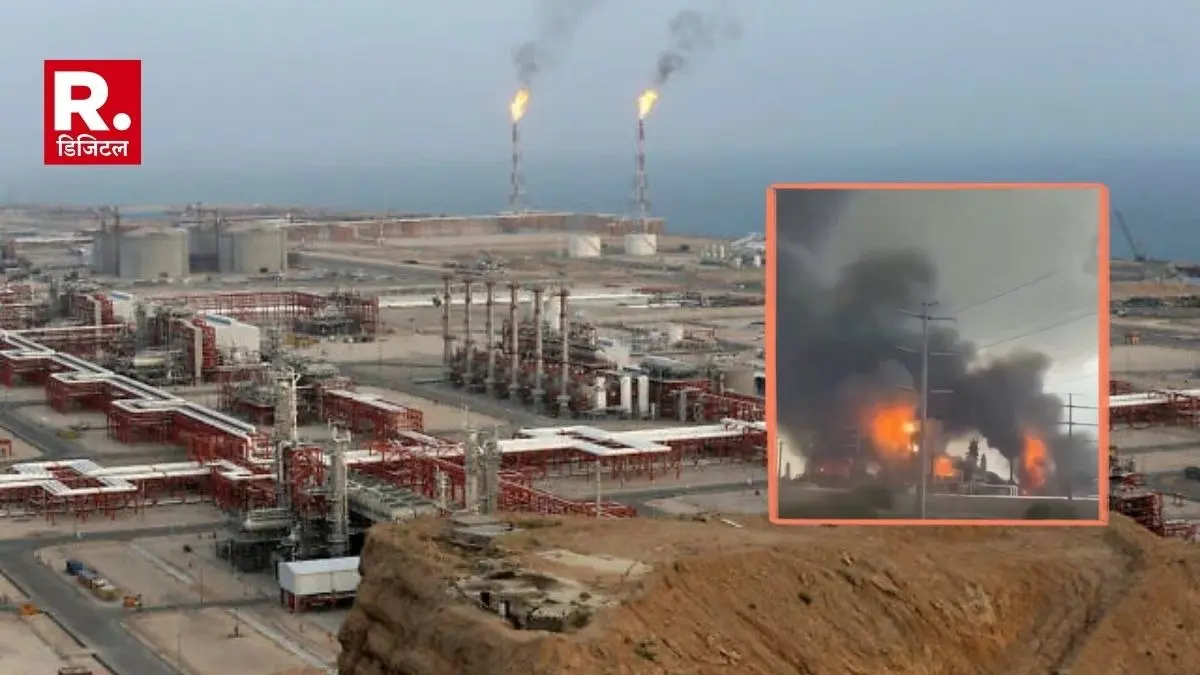
Attack on the world’s largest natural gas field. Image: AP/(Social Media)
On March 18, 2026, the Israel-Iran war reached a new level. A large-scale attack took place on the South Pars gas field in Iran. It is the world’s largest natural gas reserve, located in the Persian Gulf between Iran and Qatar. This is the first time that America and Israel have targeted natural gas sites in Iran.
Angered by this attack, Iran has threatened to attack the oil and gas fields of Gulf countries. Iran said that it has openly threatened to target five energy targets of Saudi Arabia, United Arab Emirates (UAE) and Qatar in the coming hours.
According to Iranian government media and officials, the attack targeted the petrochemical complex, processing units and several critical infrastructures located in Asaluyeh. After the attack, massive fires broke out at many places, due to which gas production came to a complete halt. Emergency teams continued to battle the fire, but initial reports suggested multiple explosions and widespread damage.
America and Israel held responsible
Iran has blamed Israel and America for this attack. This attack is believed to be a part of the ongoing military action by America and Israel against Iran, but for the first time such a major energy sector facility has been targeted. Earlier attacks had mostly focused on military or nuclear-related facilities.
Iran’s threat to these countries
Iran took a tough stance immediately after the attack. Iranian Revolutionary Guards have warned of targeting several major oil-gas sites in Saudi Arabia, the United Arab Emirates and Qatar. These include important sites such as SAMREF Refinery, Jubail Petrochemical Complex, Al Hosn Gas Field, Ras Laffan Refinery and Mesaieed Petrochemical Complex. Iran warned these countries that if the attacks continued, there would be massive retaliation.
Oil prices ‘on fire’
The attack sent shockwaves through global energy markets. Brent crude oil prices rose sharply to touch $109 per barrel, a jump of more than 5% in a matter of hours. Natural gas prices in Europe also rose by 6%. The South Pars field meets a large portion of Iran’s domestic gas needs and also plays an important role in global LNG supplies via Qatar. The disruption in production could impact the entire Gulf region’s energy supply.
This situation is worrying for India. India imports a major part of its requirement in the form of LNG from Qatar, and around 80-85% of LPG comes from Gulf countries. If tension increases in the Strait of Hormuz and the supply chain is disrupted, there could be a sharp rise in fuel prices in India. This will increase inflation at the domestic level and may deepen the energy crisis. This attack is being considered a major step towards turning the regional conflict into an economic war.
At present the situation remains very critical. Iran’s retaliation and the reaction of Gulf countries will determine how deep the energy crisis deepens. The eyes of the entire world are now fixed on the Persian Gulf, where energy supply is considered the backbone of the global economy.
Also read: LPG Gas Cylinder Rule: Cylinder has not arrived yet? So know after how many days of booking you should get it, what does the rule say