
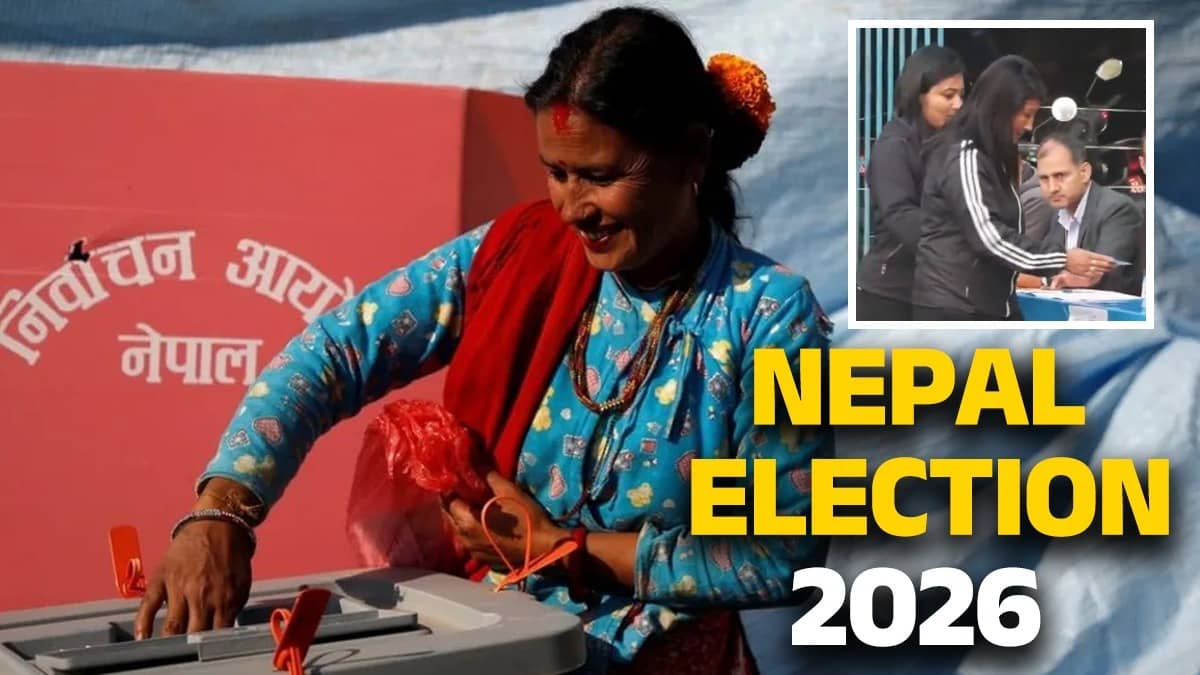
Voting has started amid tight security for the general elections in India’s neighboring country Nepal. A large number of voters are reaching the polling stations early in the morning to exercise their franchise. This is the first election after violent protests by Gen-Z last year and the fall of KP Sharma Oli’s government. Voting will begin at 7 am on Thursday, March 5, and will continue at 5 pm. This time many young faces are also in the fray. About 1.90 crore voters of Nepal will elect the new government.
Historic general elections are being held in Nepal on Thursday, March 5, 2026. This is the first major election for the country, following the youth-led Gen Z protests in September last year. In this violent protest, the youth, demanding corruption, nepotism and government accountability, had toppled the government of KP Sharma Oli. Dozens of people were killed in the violent protests. The Election Commission has made strict security arrangements regarding voting. More than three lakh security personnel have been deployed.
Former mayor and rapper Balendra ‘Balen’ Shah votes at Annapurna Vinayak School Polling Center for Nepal’s 2026 general election. Let us tell you that 35-year-old Balendra Shah, former mayor of Kathmandu, a rapper-turned-politician, is the leader of the centrist Rashtriya Swatantra Party. This time he has also presented his claim in the election field. His name is being mentioned in the race for the post of Prime Minister. Shah is giving a tough challenge to former Prime Minister Oli.
Crowd of youth at polling stations
About 1.90 crore voters of Nepal will use their votes to elect the 275-member House of Representatives. 3,406 candidates are contesting for 165 seats through direct voting and 3,135 candidates are contesting for 110 seats through proportional voting. Counting will begin immediately after the ballot boxes are collected after voting.
Prominent political faces and contenders
The demand for youth participation and change is the most discussed in this election. The Gen-Z movement has injected new energy into politics, with an emphasis on transparency, employment and accountability. A total of more than 3,400 candidates are in the fray, of which more than 1,000 are below 40 years of age. This election is proving to be a big contest between young versus old established parties in Nepalese politics. The results are expected to be announced within 24 hours for directly elected seats, although it may take time to bring ballot boxes from the hilly areas.